

Have you read the back of your store-bought bread lately?
It seems like a no-brainer for convenience—I mean, I have a big family. Convenience is HUGE. It saves time and stress. But I started paying more attention to our eating habits, and I realized we were going through a full pound of bread in just one lunch sitting. A simple, classic PB\&J didn’t go far with hungry kids.
At $2 for a store-brand loaf and up to $6 for an organic one, I knew I couldn’t afford to spend over $300 a month on “healthy” bread for just one meal a day. It wasn’t feasible. So, like many families navigating a tighter economy, I started picking the cheapest option.
Then I made a mistake.
I read the label.
I’d already stopped buying store-bought cookie dough six months earlier after glancing at that ingredient list. I still kind of wish I hadn’t looked. But since then, baking cookies from scratch had become second nature. I memorized the recipe, added the ingredients to every grocery order, nailed the perfect cook time, and even tracked the Weight Watchers points. Cookies weren’t a big deal anymore.
But bread? That felt like a whole different ball game—intimidating, inconvenient, and easy to mess up. I told myself I’d get around to making homemade bread eventually. Maybe in a year. That was my personal goal.
But then I actually read the label on our go-to store-brand whole wheat bread. And suddenly, “eventually” became “right now.”
According to the NOVA classification system, that bread is considered an ultra-processed food due to all the additives and preservatives. And diets high in ultra-processed foods have been linked to an increased risk of chronic diseases.
Chronic diseases? I thought I was trying to raise healthy kids and build a strong family—not quietly poison them with something as simple as sandwich bread.
So I kept reading—and what I found just confirmed what I feared.
There were dough conditioners like azodicarbonamide and ethoxylated mono- and diglycerides, added to simply improve texture but controversial when it comes to health. Preservatives like calcium propionate and sorbic acid help extend shelf life but can trigger sensitivities. And of course, the major concern: ultra-processed additives. This supposedly healthy bread—available at nearly every grocery store, including in our small town—contains sodium stearoyl lactylate and soy lecithin. These ingredients are common in ultra-processed foods, which have been linked in studies to higher rates of obesity, hypertension, and diabetes.
I put the loaf back on the shelf. I didn’t stop buying bread completely, but I started buying it far less frequently. Still, I couldn’t help but wish I hadn’t opened this can of worms.
Immediately, I started listing the reasons I couldn’t make bread at home. Time. Money. Energy. Emotional bandwidth. Fear of failure. But the truth was: there had to be a way to do it without sacrificing health, finances, or convenience.
We weren’t the only family feeling the pinch in this economy. But at what point were we sacrificing our health for convenience? Most people still bought their bread at the store.
Then it hit me: a bread maker.
What if the machine could do all the work, and I just supplied the wholesome ingredients? No chemicals. No stress. Just good bread—foolproof and family-friendly.
I researched machines and bought a mid-range model. Not cheap, but not fancy. On sale, it cost $120—an investment, sure, but one I hoped would pay for itself.
I also bought 5 pounds of organic flour for $8 (local grocer). Each two-pound loaf uses about four cups of flour, so one bag made roughly 4.5 loaves.
That’s just $0.88 per pound of bread in flour.
Yeast cost me $5.50 for a 4-ounce jar (local grocer). At 1.5 teaspoons per loaf, one jar made 16 loaves—0.17 per pound in a loaf.
I used my favorite—Kerrygold butter: $4.64 for 16 oz. One tablespoon per loaf meant 16 loaves per package—$0.145 per pound in a loaf**.
That meant a two-pound homemade loaf cost me only $1.51 to make using high-quality, clean ingredients.
Compare that to:
$4 for two pounds of store-brand bread
$10–$12 for organic bread at the store
MY GIRL MATH: $1.51 for homemade bread—with better ingredients and no health warnings.
All I needed was yeast, organic flour, butter, salt, and water. That’s it.
No dough conditioners.
No preservatives.
No red flags.
At that rate, I would make back the cost of my breadmaker in less than two months. I was saving $2.50 per loaf compared to the generic option—and nearly 80% compared to store-bought organic.
And time? It took less than five minutes to measure and add the ingredients. The machine handled the rest. Four hours later: warm, fresh, homemade bread that my family devoured.
I had just hacked the simple life—and mixed it with modern convenience.
Bread really could be made better again.
I had finally embraced the concept of simple living, mindful eating, and clean ingredients—without sacrificing time or money. All it took was a little research and a shift in thinking.
It worked for us. It might work for you too.
Could you toss a loaf into your breadmaker now that you know what’s in store-bought bread? It turns out that simple food and simple living may be far more convenient—and affordable—than we’ve been led to believe.
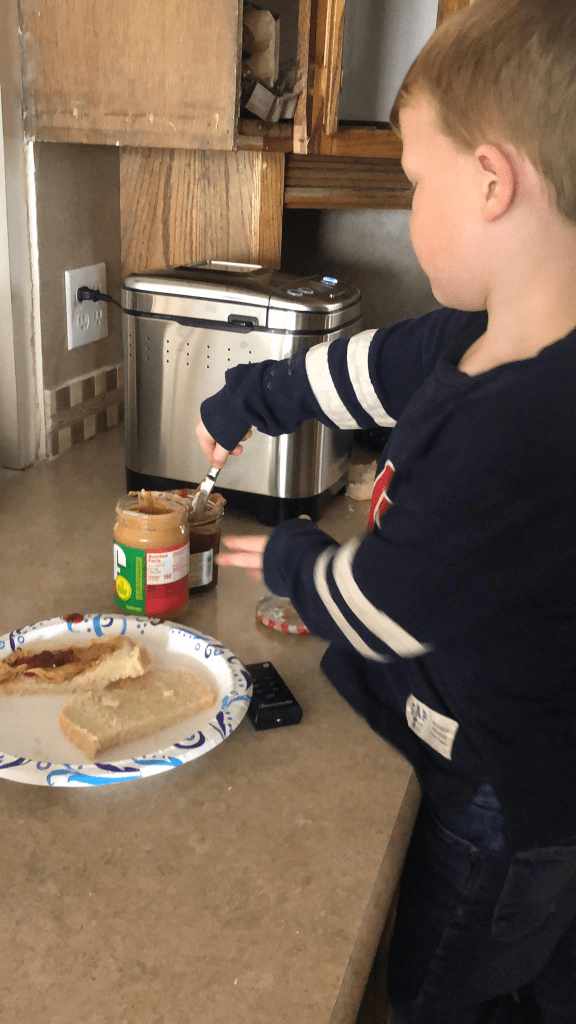
Want some help with where to start? We’ve chosen 3 items to encourage and equip you with bread making. Click the links below to find out more!

Have you read our latest book release? Check out and read The Well today!
Note: This post contains affiliate links. As an Amazon Associate, I may earn a small commission from qualifying purchases—at no extra cost to you. Thank you for supporting Simply Blooming Grace. You can read our privacy and security policy HERE.
 Simply Blooming Grace